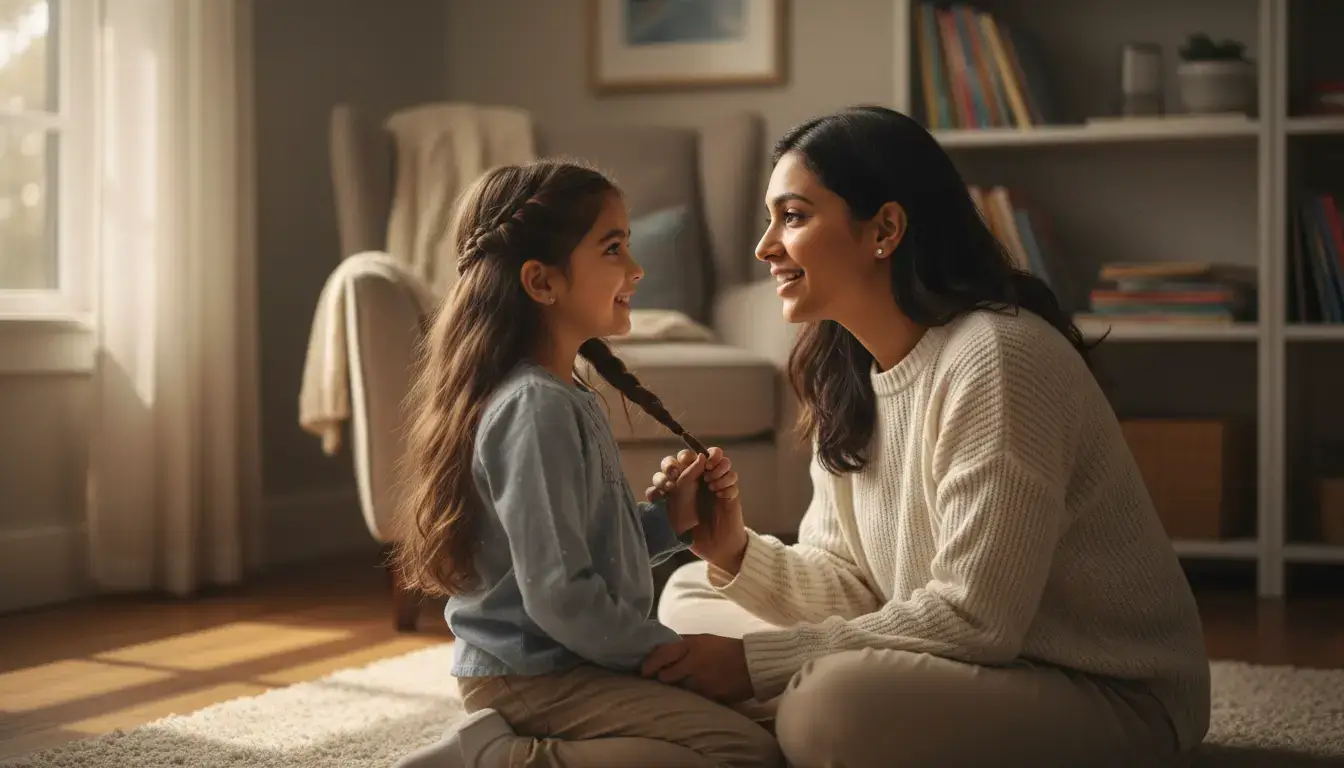

Hair. It’s just hair, right? Except, of course, it really isn’t — not when you’re a child. For many young people, children’s hair confidence is shaped from a very early age. Hair is one of the first things children become aware of about themselves — how they look in the mirror, what their classmates might comment on, and something that can shift from a source of pride to anxiety in a single careless remark.
As parents and carers, the way we talk about our children’s hair matters far more than we might realise. NHS guidance on children’s mental health highlights how early experiences shape long-term self-esteem. The words we use, the attitudes we model, and the choices we give our children all contribute to how they feel about themselves — not just about their hair, but about their whole identity. In this post, we’re exploring how to have those conversations thoughtfully, build real confidence, and help your child develop a genuinely positive relationship with their hair from an early age.
Why Children’s Hair Confidence Starts with How We Talk About It
Children’s hair confidence begins to form remarkably early. Research consistently shows that children as young as three are aware of differences in appearance and can internalise comments made by adults. Research consistently shows that children as young as three are aware of differences in appearance and can internalise comments made by adults around them. Hair is one of the most visible aspects of a child’s appearance, and for children with natural, curly, or textured hair in particular, the world around them doesn’t always reflect their experience back positively.
Offhand comments like “your hair is so wild today” or “why won’t it just lie flat?” might seem harmless to adults. But to a young child still forming their self-concept, those words can land as criticism — and that criticism can stick. Conversely, the right conversations at the right time can do something remarkable: they can give children the language and the confidence to love what they see in the mirror.
Starting the Conversation: Age-by-Age Guide
Toddlers and Pre-Schoolers (Ages 1–4)
At this age, children are sponges. They absorb language and emotional cues without fully understanding them, so what matters most is the tone and energy you bring to hair-related moments — brushing, washing, styling, and visiting the salon.
Keep things positive and playful. Instead of wrestling with a comb while muttering under your breath, try narrating what you’re doing with warmth: “We’re going to make your curls look so lovely!” or “Let’s get you all tidy and ready for your big day.” You’re not being dishonest about the occasional tangles — you’re simply framing the experience as something enjoyable rather than something endured.
Introduce them to their reflection positively. When their hair is done, hold them up to the mirror and let them see themselves. “Look at you — don’t you look brilliant?” builds a habit of positive self-regard that’s far more valuable than any specific hairstyle.
Reception and Early Primary (Ages 4–7)
This is the age when children start comparing. They notice that their hair looks different from their best friend’s, from characters on television, from the children in books. This is also the age when questions start: “Why is my hair curly?” or “Why can’t I have straight hair like Ella?” or “Why does my hair take longer to brush than Daddy’s?”
Answer these questions honestly and with genuine enthusiasm. “Your hair is curly because that’s how it grows, and curly hair is absolutely beautiful — there are so many amazing things you can do with it.” Avoid responses that dismiss the question or inadvertently suggest the difference is a problem. The goal is to validate their observation and redirect toward pride rather than comparison.
This is also a brilliant age to start involving them in choices. Let them pick a hair clip, choose between two hairstyles, or select a new hair accessory. Agency over their own appearance builds confidence and teaches them that their preferences matter.
Older Primary (Ages 7–11)
By this stage, social dynamics are more complex. Children at this age are increasingly influenced by peers, and hair can become a flashpoint — for bullying, for belonging, or for self-expression. A child who loved their Afro puffs at five might suddenly want them taken out because someone at school made a comment. A boy who’s always had his hair cut a certain way might want to grow it out because a friend does — or be told he can’t.
The most important thing you can do at this age is keep the lines of communication open. Ask curious questions rather than making assumptions: “How are you feeling about your hair at the moment? Is there anything you’d like to change or try?” Listen properly before responding. If your child is experiencing unkind comments about their hair, take it seriously, validate their feelings, and address it directly — while also reinforcing that the problem lies with the person making the comment, not with your child’s hair.
Building Children’s Hair Confidence Through Celebrating Diversity
One of the most powerful things you can do as a parent is actively celebrate the diversity of hair types — not just your child’s own hair, but hair in general. Here are some easy ways to weave this into everyday life:
- Books and representation matter. Seek out children’s books that feature protagonists with hair like your child’s. Representation in literature has a profound impact on how children see themselves as valued and normal.
- Talk about different hair types without hierarchy. Not “some people have harder hair to manage” but “all hair types are different and brilliant in their own ways.” Language shapes perception, especially in young minds.
- Share your own stories. Did you go through a phase of hating your hair? Tell them honestly. “I used to wish my hair was different, but now I really love it.” Vulnerability modelled by parents is one of the most powerful tools available.
- Explore cultural hair traditions together. If your family has heritage rooted in specific hair practices — whether that’s Afro-Caribbean braiding traditions, South Asian oiling rituals, or anything else — share those stories with your children. Hair is cultural, historical, and deeply personal.
What to Do When Your Child Is Upset About a Haircut
It happens to almost every family at some point. The scissors go slightly further than intended, or the finished style isn’t quite what your child had in mind, and suddenly there are tears — sometimes quite a lot of them. How you respond in that moment sets a precedent for how your child processes disappointment about their appearance going forward.
First and most importantly: validate the feeling before trying to fix it. “I can see you’re really upset, and that makes complete sense — you wanted it to look a certain way and it doesn’t yet” is infinitely more helpful than “it’ll grow back” or “it doesn’t look that bad.” The dismissal, however well-intentioned, teaches children that their feelings about their appearance don’t matter.
Then, once the initial emotion has settled, you can introduce perspective gently. Hair does grow back. You can try a different style next time. A new hair accessory can change the look entirely. But lead with empathy, always.
How Giving Children Choices Builds Hair Confidence
One of the most common sources of conflict around children’s hair — and one of the most overlooked — is the question of control. Whose hair is it, really? Obviously parents need to maintain hygiene and practical considerations, but within those boundaries, the more ownership a child has over their own hair, the more positively they’ll relate to it.
This might mean allowing your daughter to wear her hair loose rather than plaited when she asks, even if you think plaits look neater. It might mean letting your son grow his hair longer because he wants to, even if it’s not your preference. It might mean agreeing to try a temporary coloured hair spray for a special occasion because your child is desperate to experiment. None of these concessions are harmful — and every one of them tells your child that their preferences about their own body are respected.
The flip side: when certain styles are genuinely necessary (school requirements, for example, or hair that needs to be secured during sport), explain the reasons honestly and involve your child in choosing how. “We need your hair tied back today — would you like a plait or a ponytail?” is a simple way to preserve agency even within constraints.
How Salon Visits Shape Children’s Hair Confidence
The salon experience plays a surprisingly significant role in building children’s hair confidence. A child who has a positive, fun, affirming experience at the hairdresser’s comes away with confidence — they feel looked after, they like how they look, and they associate hair care with something enjoyable. A child who has a stressful, uncomfortable, or rushed experience can develop lasting negative associations that make every subsequent appointment a battle.
This is one of the core reasons specialist children’s salons exist — and why the environment matters so much. At Kids Hair Play, we think carefully about every element of the experience: the playful decor, the themed chairs, the patient and gentle approach from every member of our team. We know that a child who feels safe and comfortable in the salon chair is a child who leaves feeling brilliant about themselves — and that confidence goes far beyond the haircut itself.
For children with additional needs, sensory sensitivities, or anxiety around new experiences, this thoughtful approach is even more important. Every positive salon visit builds trust — not just in us, but in your child’s own sense that they can handle something that once felt scary.
Words to Use — and Words to Avoid
Here’s a quick practical reference for parents who want to be more intentional about the language they use around their children’s hair:
Instead of this…
- “Your hair is a mess / so wild / out of control”
- “Why won’t your hair just behave?”
- “You’d look so much better with straight / shorter / longer hair”
- “It’s just hair, don’t be so dramatic”
- “I wish your hair was easier to deal with”
Try this instead…
- “Your hair has so much personality today — let’s find a style that works with it”
- “All hair has its quirks — that’s what makes it interesting”
- “You look brilliant exactly as you are. What style do you fancy trying today?”
- “I can see you’re really feeling this about your hair — let’s talk about it”
- “Your hair is unique to you, and that’s something to be really proud of”
Small shifts in language can make a genuinely significant difference over time.
Conclusion: Building Children’s Hair Confidence Is an Ongoing Conversation
The way we talk to our children about their hair is, in many ways, the way we talk to them about themselves. Every brushing session, every salon visit, every question answered and every choice offered is an opportunity to build up a child’s sense of worth, confidence, and self-acceptance.
It doesn’t require perfection. It requires intention — a willingness to be thoughtful about the words we use, the attitudes we model, and the space we create for our children to feel genuinely good about who they are. When hair care becomes a source of connection and confidence rather than conflict and criticism, everyone wins.
And when it comes to salon visits that genuinely support children’s confidence and wellbeing — from the moment they walk in to the moment they leave — that’s exactly what we’re here for at Kids Hair Play.
Ready to give your child a hair experience they’ll love? Book an appointment at Kids Hair Play today — we have welcoming, child-friendly salons in Sutton Coldfield, Hagley Road, and Wolverhampton.
